
The USS John Paul Jones acted like a dog marking the lamp post, observes Ambassador M K Bhadrakumar.
'India will come increasingly in the US crosshairs if it insists on maintaining its strategic autonomy, warns Ambassador M K Bhadrakumar.

The new government needs to clearly insist on diplomatic reciprocal arrangements with China. While reciprocity is a function of power in bilateral relations, the Modi-led government's responses should be based on India'S inherent strengths, says China expert Srikanth Kondapalli.

'India has ramped up infrastructure on its side, so the Chinese military is finding Indian soldiers in locations where they are not used to seeing an Indian footprint,' points out Harsh V Pant.

In his opening remarks at a ministerial meeting in Tokyo of the Quadrilateral coalition, also known as 'Quad', External Affairs Minister S Jaishankar said India remained committed to a rules-based world order, respect for territorial integrity and sovereignty, and peaceful resolution of disputes.
Russia and China are tight-fisted and Iran is broke and none of them has the political will or capacity to bankroll the Afghan economy, which only the US can, points out Ambassador M K Bhadrakumar.

'Washington appears to be playing the long game, and making the argument to India that over the longer term, Russia -- sanctioned, cash-strapped, isolated by the West -- will no longer be a viable defence partner for India'

India is no longer shying away from playing a role on the regional and international stages and is willing to don a bigger role in regional politics. It is showing traits of a responsible stakeholder in the regional security dynamics, says Dr Rahul Mishra.

The two countries also signed three other agreements -- to enhance aviation links, to jointly work in the area of energy efficiency and promotion of parliamentary cooperation.


New Delhi must indicate to Afghan President Ashraf Ghani that it has a long-term strategy for his country. It should point out that Pakistan's present Afgan policy will destabilise Afghanistan and help Islamic State, says Gautam Sen.
'If his three priorities are the economy, the economy, the economy, then there is need for a stable region, a stable neighbourhood.'

The increase in home-grown radicalised Islamic groups and the rise of Islamic State and Al Qaeda in Bangladesh should be a matter of worry for India, which shares a 4,100 km border with its eastern neighbour, says Rajeev Sharma.

'During his visit to Vietnam on September 3 -- the first visit by an Indian prime minister in 15 years -- Modi will notice the widespread anti-China sentiment in that country.'

The BRICS summit made clear that China's support for Pakistan is unwavering. China will continue to pressure India to ease tensions with Pakistan and resolve the Kashmir dispute.

Vijay Keshav Gokhale's tenure as foreign secretary promises to guide India's external affairs along paths never taken before, says K P Nayar.

Had India agreed to join the trade pact, Indian markets would have been flooded with cheap Chinese products.
There is a sense of relief in Beijing that Modi will be at the helm of affairs in Delhi at a critical juncture in the geopolitics of the region, says Ambassador M K Bhadrakumar.

Indians at large harbour a notion that their country is cherrypicking out of the American basket of goodies, but the policymakers in Delhi and the political leadership are well aware that it can only be a pipe dream since a military alliance with a superpower is a profound irrevocable commitment, observes Ambassador M K Bhadrakumar.

'The muscularity of the last three years didn't bring any dividends and if anything, Chinese attitudes only hardened,' says Ambassador M K Bhadrakumar.

'China's deep involvement in the stability and economic and political success of Pakistan actually produces some elements of congruence with India's core interest in a stable and productive relationship with Pakistan.' 'It is not far-fetched for us to pursue that congruence and with ingenuity work out with China a formula that also satisfies our formal position on PoK,' argues Ambassador Kishan S Rana.

With a decelerating economy that weakens India's hands on geopolitical issues, it will be interesting to know which way this trip will go.

India offers $1 billion towards Afghanistan's development during Afghan President Ashraf Ghani's visit.

New Delhi and Beijing are the only two regional capitals that have commented on US President Donald Trump's speech on August 21 outlining the way forward in Afghanistan. The Indian foreign ministry statement was effusive in praise, while the Chinese statement has been one of cautious and guarded hope. Delhi has identified itself with Trump's Afghan strategy, whereas the Chinese stance is calibrated -- observant and objective, keeping a distance, says Ambassador M K Bhadrakumar.
'The world does not care about the tension on our border.' 'India has to emerge as a strong economic power.' 'Respect comes when the world sees a country with a direction and leadership that has a vision,' points out Ramesh Menon.

This is Modi's first bilateral visit to Myanmar.

'While China expressed reservations on the Indian role in the South China Sea, Beijing threw to the winds Indian concerns on Kashmir by announcing $46 billion in investments Pakistan occupied Kashmir,' says Srikanth Kondapalli.
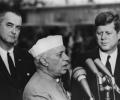
As Prime Minister Narendra Modi begins his historic visit of the United States of America, here's a look at some landmark visits by Indian prime ministers to the United States of America.

Prime Minister Narendra Modi's visit to Myanmar is aimed at transforming the arch of Bay of Bengal into the Circle of Southeast Asia, says Anirban Ganguly.
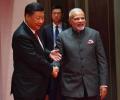
'We must compartmentalise issues, ensuring that one disagreement does not sour everything,' advises Ambassador Kishan S Rana.

Since the US and India broadly share similar interests in Sri Lanka, they should coordinate closely to ensure that the country preserves its democratic institutions, says Lisa Curtis

'What gives hope is that Modi's own leadership is vitally linked to his capacity to deliver on the economic front. Indeed, if he succeeds, India's foreign policies will have changed beyond recognition,' feels Ambassador M K Bhadrakumar.
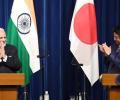
'Relations between India and Japan are robust and devoid of either shadow of history or any irritant.' 'In fact, there is plenty of warmth and goodwill earned over history. There are no negatives but only opportunities,' notes Dr Rajaram Panda.
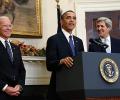
'The threat that India faces and the threat the United States faces is not just to the homeland, but to our people and to our institutions wherever they may be.' In an exclusive conversation with Aziz Haniffa/Rediff.com, US Assistant Secretary of State Nisha Desai Biswal outlines the importance of Prime Minister Modi's visit for America.

Is North Korea really dismantling its nuclear programme? Rajaram Panda explains the many challenges to denuclearise the Korean Peninsula.

'To consider BRICS anything more than a temporary club with some common interests would be folly. The goal should be to induce others (Japan, ASEAN, South Africa) to align with us -- a non-threatening, democratic nation, rather than with malevolent China or waning America. For us to consider aligning with either China or the US would be absurd. India is just too big to be a sidekick,' says Rajeev Srinivasan.

'We use the word "historic" perhaps too much, but the prime minister's visit certainly was historic in so many ways.'

20 years ago this day, May 11, 1998, India conducted its second nuclear test at Pokharan in Rajasthan. In a fascinating interview on Rediff.com, K Subrahmanyam revealed how Indian PMs reacted to nuclear ambitions.

This is the joint statement issued by the ministry of external affairs on the visit of US President Barack Obama to India.
